For Your Consideration: Titanium Court
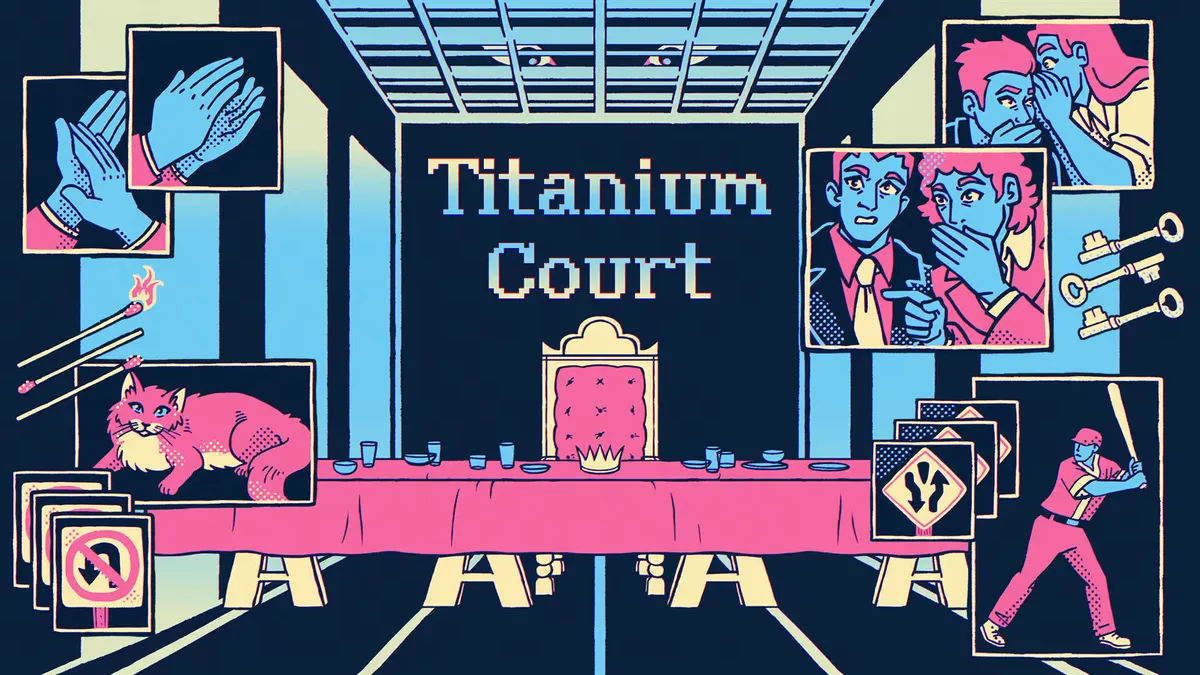
It’s been a great year for games, but I’m pretty confident that my game of the year will be AP Thomson’s Titanium Court.
If you know my inclination for indie games, this probably isn’t a surprise — Titanium Court won both the Grand Prize and Best Design awards at this year’s Independent Game Festival in advance of its public release.
I honestly was pretty mystified with these results since I hadn’t tried the game and the trailer didn’t do much to sell me on what was special about it, but based on how much I enjoyed Consume Me, a game by Jenny Jiao Hsia with AP Thomson and previous IGF Grand Prize winner, I was pretty sure I’d end up liking Titanium Court too. And I did! So much that I couldn’t put it down until I finished it.
Titanium Court is currently sitting over 1,000 reviews on Steam, which to be fair is an extremely respectable number for a mainly solo developed project, but I still can’t help but feel it’s criminally underappreciated for how well it lands its uniqueness.
That said... I don’t think it’s that surprising it didn’t spread further given how hard this game is to describe (and even the official marketing copy likes to prance in circles around the game) and how it's impossible to talk about what makes it special while avoiding spoiling it to others.
Regardless of that, I want to take a stab at talking about Titanium Court and why I think it’s great.
The Gameplay
AP Thomson is no stranger to match-3 — before Titanium Court and Consume Me, he was already winning IGF awards for Beglitched. While on the surface it may just look like another match-3, Titanium Court’s twist is adding a tower defense style phase in-between matching sessions: matching tiles will give you materials you can then spend to deploy a variety of different units during the tower defense phase.
You cannot add more units or command them during battle so it may seem simple at first, but the combination of these systems has a lot of organic depth:
- You have a limited amount of moves before the match-3 phase switches to the tower defense phase. You can focus on getting the materials you need for the units you want to deploy, but moving tiles to match them will also move your base - can you find a way to get the materials you need while leaving your base in an optimal position?
- Enemies bases can also be matched to make them disappear, allowing you to whittle down your opposition before the battle even starts. But, you won’t get any materials for matching them, which can be an issue if there is something you need to build or purchase.
- The tower defense phase runs on a timer and you “win” by surviving until the timer ends - you can be aggressive to get resources from enemies, or try to hide in a corner and survive.
Of course, like any self-respecting indie, this is all wrapped up in a roguelite structure where you start with limited resources, must pick locations from the map, and slowly build up your resources and available units to prepare for a final boss encounter. There also different classes to unlock which all have slightly different starting units and quirks which allow you to approach your runs in different ways. While I was ultimately most successful in my runs with the merchant class, burning down the field with the pyromaniac class never got boring.
Despite the positive impression I may be giving, I actually didn’t like the gameplay at first! I kept on having runs where I felt like I was playing optimally but would eventually get crushed midway through a run without even seeing the boss. I slowly got better, but my main crutch was the game’s difficulty modifier system. Certain actions (like losing a run) slowly grant you “comfort” points you can use at the start of a run to grant yourself boons that range from additional resources to the ability to skip a battle at will. There is also a “strife” point system that makes the game more challenging for the sake of challenge (and well, optional narrative).
While I had to rely on comfort points to make it through my first run of the game, I eventually began to understand all the small tricks and dynamics at play in each round, and gradually got better to the point that I was able to complete my second run of the game without relying on them (and actually had to use strife points to keep it interesting!).
While you’ll see reviews of the game talk about the gameplay growing a bit tedious towards the end, I can’t help but admire how deeply AP Thomson explores his own design.
While there’s an entire alternative variation I won’t spoil, I’m thinking about how the game gives you a lot of quirky goals beyond reaching the end of a run such as “gather this specific combination of units in your arsenal” or “hold this specific number of each material”. I totally understand the people who find these goals annoying (even if partially justified by the narrative), but I personally loved how it made me approach the game in a totally different way for each one.
The Narrative
If you know me, you know I generally won’t stick to a game for long if I’m not interested in the story. As you may guess, Titanium Court has an exceptional narrative with the (current!) description of the game on Steam describing it as "a clever ploy to trick gamers into reading my book.”
I’m not sure there’s any good way to describe it, but one way to do it is to call the story A Midsummer Night’s Dream meets Alice in Wonderland with a health dose of Undertale.
That probably doesn’t make too much sense, does it?
Well… I can also attempt to describe the plot: the story follows a human who happens upon a court of fairies who decide to make this human their queen. The court lives in a constant state of war against the “Enemy”, but everyone comes back to life at the start of the day, meaning everyone’s attitude to the war is extremely light and jovial. The queen’s servant, Puck, seems friendly at first, it quickly becomes apparent he wants the queen gone as soon as possible. What secrets is the court hiding?
Titanium Court focuses most of its exposition in the breaks between runs in a manner similar to games like Hades, where the game reacts to your actions and shows appropriate narrative beats. Despite most of the narrative happening in these sections, AP Thomson does a great job of also making sure there’s a healthy amount of narrative during the runs themselves — there are many quirky scenes as a result of the Queen attempting to explain everyday human objects like cars to the fairies.
As you may guess, it’s especially challenging to describe what makes the narrative special without spoiling it… but I’ll just say the story did a great job of making you care about the characters, and then play with that relation in ways I’ll be thinking about for years to come.
The Point
I rarely replay games, but I went straight to replay Titanium Court as soon as I finished my first run to make sure I could get the whole story. There are so many cool, small details in the game I didn’t touch upon in this post that I might just write a spoiler-full post so I can blab about it another time…
But for now, I hope I’ve convinced you to check it out! Titanium Court is available now on Steam, Switch, PS5, iOS and Android.
{{ end }}